
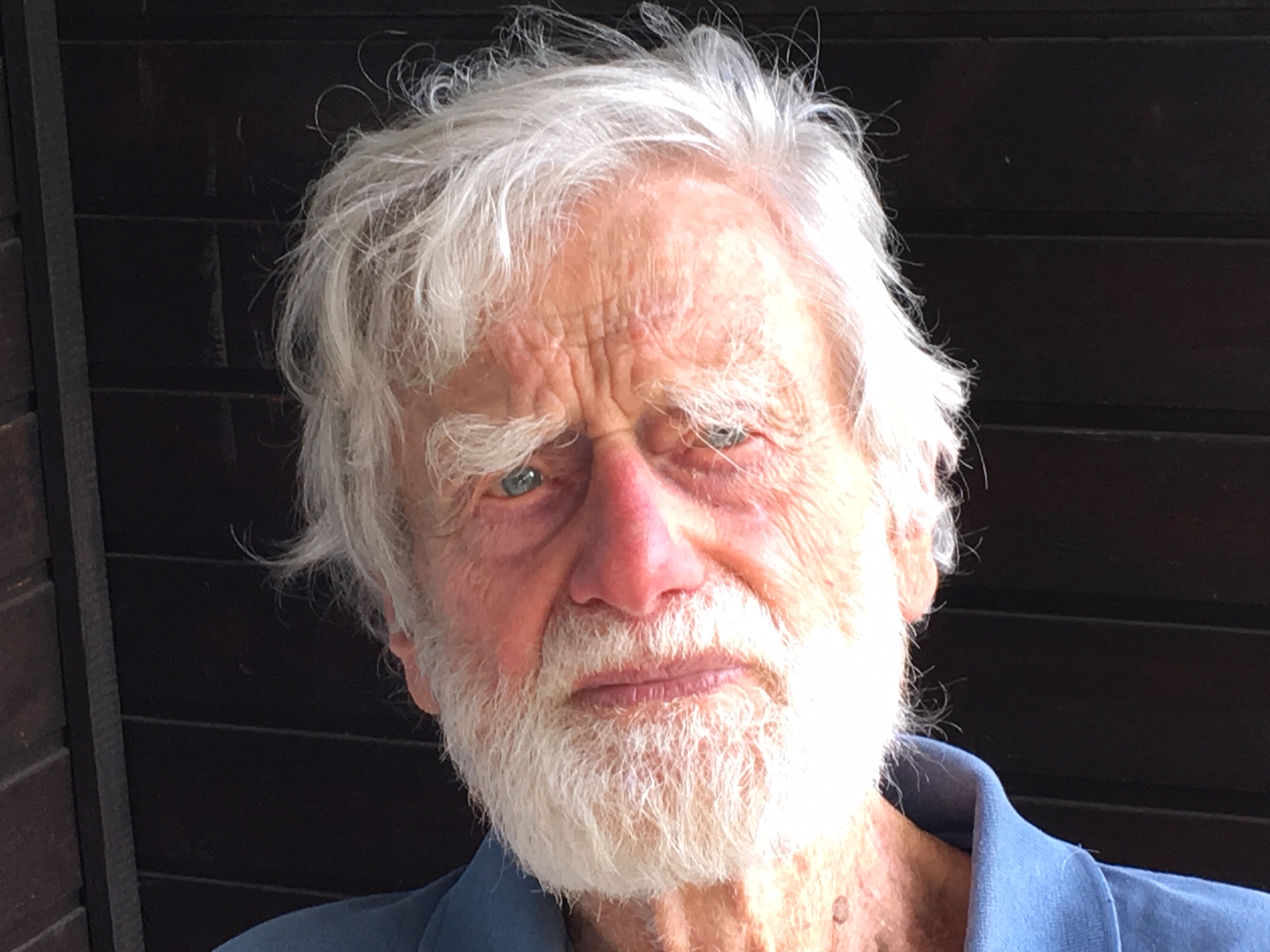
Herwig Schubert, born in Salzburg in 1926, spent his early years in the family home on Universitätsplatz. The Baroque city with its narrow streets, alleyways, wide squares, churches, and the nearby Salzach river, surrounded by idyllic rural landscapes and alpine grandeur, shaped his early childhood. In the early 1930s, the family moved to Darmstadt, where his father, a chemist, took up a senior position at the pharmaceutical company Merck.
From childhood and adolescence onwards, Schubert showed a profound passion for drawing and painting, and his need to be outdoors in nature was just as strong. As a student at grammar school, he loved outdoor sports. He went on cycling trips and canoeing tours in folding boats with his schoolmates and went hiking in the Austrian Alps with his family – always with his painting supplies in his rucksack. He learned to ride a horse, but grew increasingly withdrawn as pressure from the Nazi regime intensified.
After graduating from high school, he studied architecture for one semester before being drafted into military service as a dispatch rider in 1944 at the age of 18. In the midst of the war, he found hideways to make pencil sketches. Sketches of his horse, the end of the war near Tangermünde and his captivity have also been preserved. After his release, Schubert studied architecture for another semester at the Technical University in Darmstadt, where he became Professor Hermann Geibel’s ‘assistant in freehand drawing’.
With the reopening of the State Academy of Fine Arts in Stuttgart in the summer semester of 1946, Schubert was finally able to begin his studies in painting. His teachers included Rudolf Yelin and Hermann Sohn, who described his student Schubert in his semester reports as ‘independent, headstrong and very talented’. Artistic journeys through France, Italy and Greece, as well as solitary expeditions on foot through various Nordic countries, satisfied his urge to go his own way, both in life and in his artistic work.
After completing his studies, Schubert set up his own studio on Uhlandshöhe in Stuttgart. There he devoted himself to his art and immersed himself in history, literature and music. Even as a student, it was clear to him that he could and wanted to work only in a representational style. Nature and humanity were the focus of his interest and remained central themes throughout his life. Schubert said that he felt closer to the Baroque tradition of his homeland than to the abstract art of the post-war period. Another decisive factor was his keen eye for observing his surroundings. His early experiences with political power structures, mass movements and violence during his school years and time as a soldier fostered in him a critical detachment from people and at the same time deepened his intense connection to nature, of which he considered himself a part. This gave rise to representational art in his studio that is characterised by an intense preoccupation with the depiction of nature and the question of human existence.
In 1958, Schubert accepted an invitation from the Academy of Applied Arts in Istanbul, where he taught painting classes for four years. Former students, who later became professors at the academy, remained in contact with Schubert throughout their lives.
After returning to his studio in Stuttgart, Schubert received various commissions in the field of ‘art in architecture’, including the mosaic in Stuttgart City Hall and the entrance portal of St. Vinzenz-Pallotti Church in Birkach. Illustration commissions followed from Rupertusblatt (the weekly newspaper of the Archdiocese of Salzburg), Ueberreuter Verlag and other renowned publishers such as Herder Verlag and Hoch Verlag, which secured his livelihood and suited his talent as an illustrator of dynamic and energetic scenes.
In addition to his illustrations, Schubert developed his own drawings in ink and mixed media. He also painted large-format pictures in oil, which show stylistic echoes of abstract expressionism. The subjects are Arctic landscapes, female figures, horses and battle scenes. These often monumental oil paintings rarely, if ever, left his studio, as Schubert was concerned that they would be neither understood nor accepted as they didn’t fit the times.
His focus on figurative work earned him a position as a substitute for Alfred Hrdlicka, professor of sculpture at the State Academy of Fine Arts in Stuttgart, from 1973 to 1974, as well as a subsequent teaching position in nude drawing, which quickly developed into figurative painting under his guidance. Schubert was appointed professor in 1979. He was a member of the academy’s senate for many years, cultivated collegial relationships and taught his students with great dedication.
Solo exhibitions were held in southern Germany and Austria, where he found particular appreciation from the renowned art historian Otto Breicha. Schubert remained a loner who was not influenced by trends or opinions and cared little about his presence on the art market. Those who knew him appreciated him as an attentive conversationalist and a discreet personality. His students experienced his rigorous thinking and actions, his vitality and his sensitive response to individual talents. His deep love of untamed nature and his exploration of the ongoing and complicated existential drama between man and the natural world found expression in his work.
Well into old age, he was drawn every year to the inaccessibility and solitude of the Arctic countries, to rivers in the Canadian wilderness and to the sea, where he found the majesty of nature, personal experiences that pushed his limits, and freedom. These expeditions into the open and unknown were both adventure and home to him, in his painting as in his life.
On the evening after visiting the outstanding Kokoschka retrospective at the Kunsthaus Zurich in February 2019, Schubert remarked in conversation, ‘Painting is my home.’ And painting remained his ‘last adventure’ until his death.
In the early morning, before returning home to his studio in Buchenberg, where he wanted to devote himself once again to his landscape cycle ‘Pictures of the Sea’, Schubert died of heart failure at the age of 92.

